


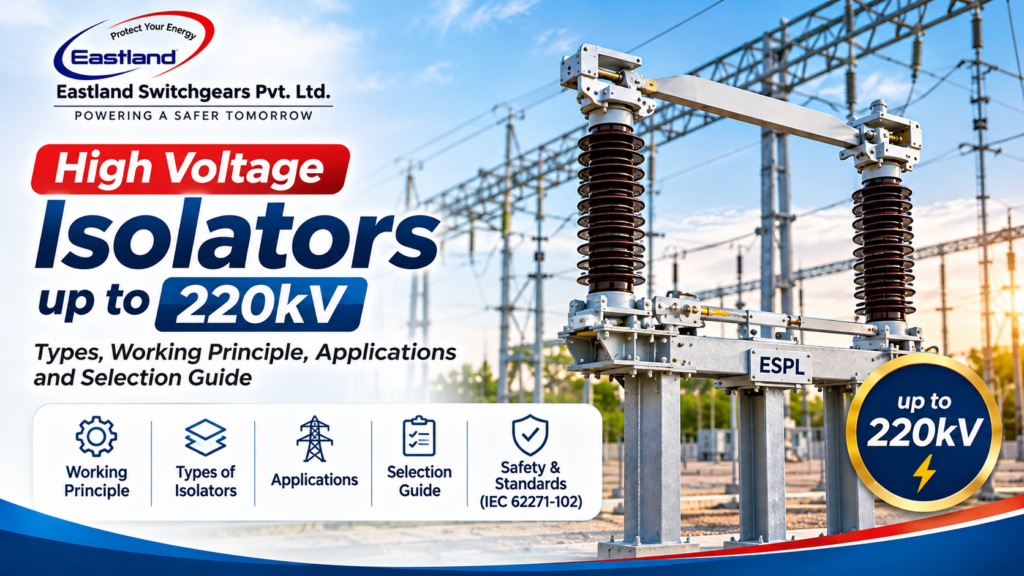
High Voltage Isolators up to 220kV: Types, Working Principle, Applications and Selection Guide
Introduction
Electrical substations and power transmission networks require reliable switching and isolation equipment to ensure safe operation and maintenance. One of the most important components used in these installations is the High Voltage Isolator, also known as a Disconnector.
A high voltage isolator is designed to electrically isolate a particular section of an electrical circuit or equipment from the power supply. It allows maintenance engineers and technicians to work on transformers, circuit breakers, transmission lines and other substation equipment after the circuit has been safely de-energised.
Unlike circuit breakers, isolators are not designed to interrupt normal load current or fault current. They provide visible electrical isolation after the current has already been interrupted by an appropriate switching device.
Eastland Switchgears Pvt. Ltd. (ESPL) offers isolator solutions for high-voltage substation applications up to 220kV. With experience in the electrical switchgear industry since 1984, ESPL supports electrical infrastructure requirements with dependable switchgear and distribution solutions.
In this guide, we will discuss the working principle, types, applications, safety requirements and important factors to consider when selecting a high voltage isolator.
What Is a High Voltage Isolator?
A High Voltage Isolator is a mechanical switching device used to disconnect an electrical circuit or equipment from its power source to provide a safe isolation condition.
It is commonly installed in electrical substations, transmission networks and high-voltage switching installations.
The main purpose of an isolator is to provide a physical separation between electrical conductors so that maintenance or inspection can be carried out safely.
High voltage isolators are commonly used to isolate:
- Power transformers
- Circuit breakers
- Busbars
- Transmission lines
- Substation equipment
- Other high-voltage electrical installations
An isolator is generally operated only when the circuit is not carrying load current. The associated circuit breaker or other suitable switching device must interrupt the current before the isolator is opened.
Working Principle of a High Voltage Isolator
The working principle of a high voltage isolator is based on mechanical separation of electrical contacts.
Unlike a circuit breaker, an isolator does not have an arc-extinguishing mechanism designed to interrupt load or fault current.
The general operating sequence is explained below.
Step 1: Circuit Interruption
Before opening the isolator, the circuit breaker or appropriate switching device interrupts the electrical current.
Step 2: Isolator Operation
Once the circuit is safely de-energised, the isolator is operated to separate its electrical contacts.
Step 3: Physical Isolation
The opening movement creates a visible isolation gap between the conducting parts.
Step 4: Safety Locking
The isolator can be secured using suitable locking arrangements or interlocking systems to prevent accidental operation.
Step 5: Maintenance Work
After confirming the required isolation, absence of voltage and application of appropriate earthing and safety procedures, maintenance personnel can work on the isolated equipment.
The exact switching sequence must follow the approved substation operating procedure and utility safety regulations.
Why Are High Voltage Isolators Important in Electrical Substations?
High voltage isolators play an essential role in electrical system safety and maintenance.
1. Safe Equipment Isolation
Isolators help separate electrical equipment from the power supply before maintenance activities.
2. Visible Isolation
The physical contact separation provides a visible indication that the relevant circuit section has been isolated.
3. Maintenance Convenience
They allow electrical engineers to isolate individual sections of a substation for inspection, testing and repair.
4. Operational Safety
Suitable locking arrangements and interlocking systems help prevent unintended operation.
5. Flexible Substation Operation
Multiple isolators can be installed in substation arrangements to provide different equipment and busbar isolation configurations.
Types of High Voltage Isolators
High voltage disconnectors are available in different designs depending on substation layout, electrical clearances, operating requirements and available installation space.
The major types include:
1. Centre-Break Isolator
<image_placeholder>
A Centre-Break Isolator uses two rotating contact arms that separate from each other at the centre during opening.
Key characteristics:
- Horizontal contact movement
- Commonly used in outdoor substations
- Suitable for different high-voltage applications
- Requires appropriate phase-to-phase and phase-to-earth clearances
2. Double-Break Isolator
A Double-Break Isolator generally uses a central moving contact arrangement that creates two breaks in the electrical circuit during opening.
Key characteristics:
- Two contact separation points
- Suitable for selected substation configurations
- Designed to provide electrical isolation
- Selection depends on rated voltage and insulation requirements
3. Pantograph Isolator
A Pantograph Isolator uses a vertically extending contact arrangement that connects with an overhead contact system.
Key characteristics:
- Vertical operating movement
- Compact arrangement in suitable substation layouts
- Useful where horizontal space is limited
- Often considered for specific busbar configurations
4. Horizontal Break Knee Isolator
This type uses a knee-shaped articulated contact arrangement to create a horizontal isolation gap.
Key characteristics:
- Horizontal opening arrangement
- Special mechanical operating geometry
- Used in selected high-voltage substation designs
- Requires suitable installation clearance
5. Vertical Break Isolator
A Vertical Break Isolator opens by moving its contact assembly in a vertical direction.
Key characteristics:
- Vertical contact separation
- Suitable for specific outdoor substation arrangements
- Can be selected according to available space and electrical clearance requirements
6. Coaxial Isolator
A Coaxial Isolator uses a concentric contact arrangement in which the moving and fixed contact components are positioned along a common axis.
Key characteristics:
- Specialised contact arrangement
- Designed for specific substation configurations
- Selection depends on the electrical and mechanical design requirements
The appropriate isolator type depends on rated voltage, substation layout, clearances, mounting arrangement and operational requirements.
Applications of High Voltage Isolators
High voltage isolators are widely used in electrical infrastructure and power transmission installations.
1. Electrical Substations
Isolators are installed in substations to isolate transformers, circuit breakers, busbars and other electrical equipment during maintenance.
2. Power Transmission Networks
Transmission networks use high-voltage disconnectors to provide isolation of selected line sections and associated equipment.
3. Power Generation Plants
Power generation facilities use isolators in switchyards and high-voltage installations to support safe equipment maintenance.
4. Industrial Electrical Installations
Large industrial facilities with high-voltage substations require isolation equipment for maintenance and operational safety.
5. Renewable Energy Projects
Solar and wind power projects connected to high-voltage transmission or substation networks may require isolators as part of their electrical switching arrangements.
6. Utility Infrastructure Projects
Electricity transmission and distribution utilities use high voltage isolators in substations and grid infrastructure.
Difference Between Isolator and Circuit Breaker
Although both devices are used in electrical switching installations, their functions are different.
| Parameter | Isolator | Circuit Breaker |
|---|---|---|
| Main Function | Provides electrical isolation | Interrupts electrical current |
| Load Current Interruption | Not intended for normal load interruption | Designed for rated load current interruption |
| Fault Current Interruption | Not designed for fault interruption | Designed to interrupt specified fault currents |
| Arc Extinguishing Mechanism | Generally not provided for load/fault interruption | Provided |
| Operation | Normally after current interruption | Can operate under specified load and fault conditions |
| Main Application | Maintenance and safety isolation | Switching and electrical protection |
Important: An isolator must not be operated to interrupt load or fault current unless it is specifically designed and rated for that switching duty.
Isolator vs Earthing Switch
An isolator and an earthing switch have different but complementary safety functions.
| Parameter | Isolator | Earthing Switch |
|---|---|---|
| Main Purpose | Disconnects equipment from the supply | Connects isolated equipment to earth |
| Function | Provides electrical separation | Provides an earthing connection |
| Application | Equipment isolation | Safety earthing during maintenance |
| Operation | According to approved switching sequence | Only after confirming the required isolation and absence of voltage |
In some designs, an isolator assembly may include an integrated earthing switch. The arrangement depends on the equipment design and project specification.
Important Technical Factors When Selecting a High Voltage Isolator
Choosing the correct isolator is essential for the safety and reliability of an electrical substation.
Before selecting a high voltage disconnector, consider the following factors.
1. Rated Voltage
The rated voltage must match the electrical system and the applicable equipment voltage class.
2. Rated Current
The continuous current rating should be suitable for the maximum expected operating current of the circuit.
3. Short-Time Withstand Current
The isolator must have an appropriate short-time withstand current rating based on the fault level and protection-clearing time of the installation.
4. Peak Withstand Current
Check the peak withstand current requirement to ensure the equipment can withstand the specified electrodynamic forces.
5. Insulation Level
Consider the power-frequency and lightning impulse withstand requirements for the installation.
6. Operating Mechanism
Select a suitable manual or motor-operated mechanism according to the substation operating requirements.
7. Mounting Arrangement
Consider the available installation space, support structures, mounting height and electrical clearances.
8. Environmental Conditions
The isolator should be suitable for the installation environment, including temperature, humidity, pollution and wind conditions.
9. Interlocking and Safety Features
Check the requirements for mechanical interlocking, electrical interlocking, locking arrangements and earthing switches.
10. Standards and Technical Documentation
Review applicable standards, approved drawings, technical datasheets and routine or type-test documentation before finalising the equipment.
IEC 62271-102 Standard for High Voltage Disconnectors
IEC 62271-102 is an important international standard covering alternating-current disconnectors and earthing switches.
It defines relevant requirements and features for these devices, including their operating and electrical performance.
When purchasing a high voltage isolator, buyers should check:
- Applicable rated voltage
- Rated normal current
- Short-time withstand current
- Peak withstand current
- Insulation requirements
- Mechanical operating requirements
- Earthing switch requirements, where applicable
- Relevant type-test and routine-test documentation
The required standard edition and project-specific compliance should be verified against the latest applicable technical specifications.
Why Choose Eastland Switchgears for High Voltage Isolators?
Eastland Switchgears Pvt. Ltd. (ESPL) has been associated with the electrical switchgear industry since 1984.
The company offers high-voltage isolator solutions for substation applications up to 220kV.
ESPL focuses on electrical equipment and infrastructure requirements for utility, industrial and power distribution projects.
Key reasons to consider ESPL:
- Experience in the electrical switchgear industry since 1984
- High Voltage Isolators up to 220kV
- Solutions for electrical substation applications
- Different disconnector configurations for suitable project requirements
- Focus on electrical safety and reliable isolation
- Technical support for product enquiries and project requirements
For detailed product selection, customers should consult the ESPL team regarding the required voltage class, current rating, short-time withstand rating, operating mechanism and installation arrangement.
Frequently Asked Questions (FAQs)
1. What is a high voltage isolator?
A high voltage isolator is a mechanical switching device used to disconnect electrical equipment from a power source and provide a safe isolation condition for maintenance.
2. What is the difference between an isolator and a disconnector?
The terms isolator and disconnector are commonly used for the same type of electrical switching device that provides isolation. Terminology may vary across industry and technical documentation.
3. Can an isolator interrupt load current?
A conventional isolator is not designed to interrupt normal load current or fault current. The current must first be interrupted by an appropriate circuit breaker or switching device.
4. What are the main types of high voltage isolators?
The main types include Centre-Break, Double-Break, Pantograph, Horizontal Break Knee, Vertical Break and Coaxial disconnectors.
5. What is the purpose of a Centre-Break Isolator?
A Centre-Break Isolator separates two rotating contact arms at the centre to create an electrical isolation gap.
6. What is IEC 62271-102?
IEC 62271-102 is an international standard covering AC disconnectors and earthing switches.
7. Where are high voltage isolators used?
They are used in electrical substations, transmission networks, power generation plants, industrial installations and utility infrastructure projects.
8. Up to what voltage does ESPL offer isolators?
The ESPL product page lists High Voltage Isolators up to 220kV. For model-specific ratings and technical details, contact the company.
Conclusion
High Voltage Isolators are essential components of electrical substations and transmission networks. They provide physical electrical isolation, support safe maintenance and help improve the operational safety of high-voltage installations.
Selecting the correct isolator requires careful consideration of rated voltage, current capacity, withstand ratings, insulation level, operating mechanism, installation arrangement and applicable standards.
Eastland Switchgears Pvt. Ltd. offers isolator solutions for applications up to 220kV, supporting the requirements of electrical infrastructure and substation projects.
Looking for a High Voltage Isolator up to 220kV for your next substation project? Contact Eastland Switchgears Pvt. Ltd. for product information and technical assistance.
Contact Eastland Switchgears Pvt. Ltd.
Eastland Switchgears Pvt. Ltd. (ESPL)
Protect Your Energy | Powering a Safer Tomorrow
Factory Address:
Sankrail Industrial Park, Dhulagarh, Howrah, West Bengal, India.
For Sales Enquiry:
Phone / WhatsApp: +91 84208 10036
For Service Contract & Technical Support:
Phone: +91 79806 89618
Email: info@esplindia.in
Website:
https://esplindia.in/
https://www.eastlandswitchgears.com/
Explore Our Isolator Products:
https://esplindia.in/isolators/